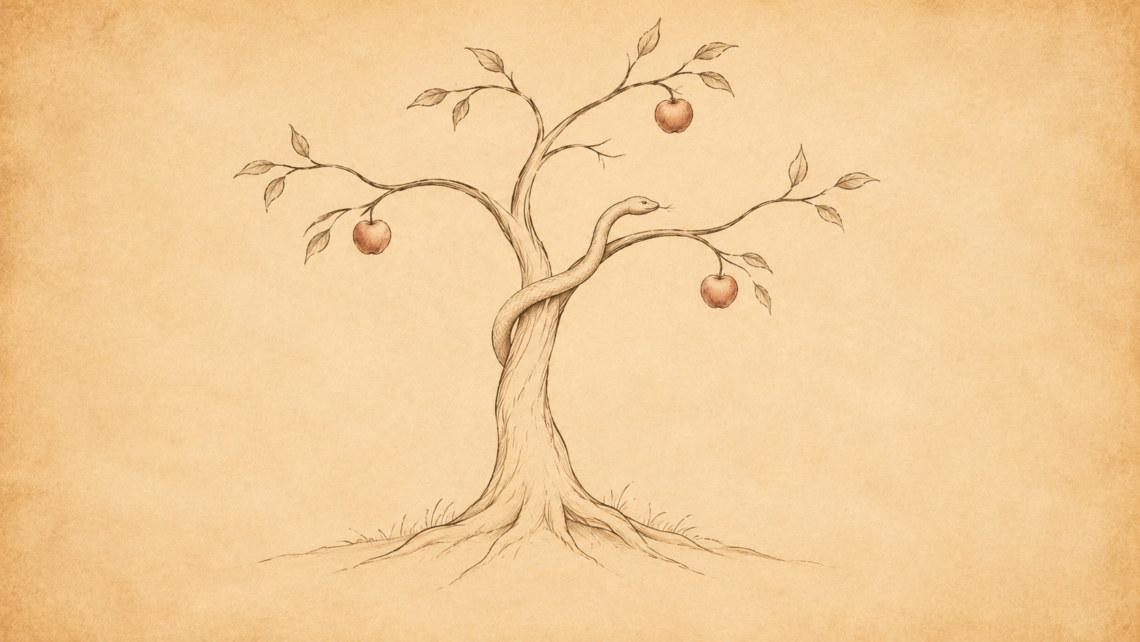
Circling the Tree
On love, longing, and the things we were never meant to live without.
There was a time when man wanted for nothing. Made from the dust of the earth, yet bearing the image of God. Fragile in his humanity, yet crowned with glory and honor. He had needs, certainly. He was made to need. But every need found its answer in the One who had made him. He was known. He was loved. He belonged. And there was no fear in being known. Before shame, before hiding, before the exhausting pursuit of becoming someone worthy of love, there was simply love itself. Freely given, freely received, and freely returned. A beautiful, unbroken communion between the Creator and His creation.
And then came a question. “Did God really say?” How strange that the first great deception began not with the denial of God’s existence, but with the distortion of His character. Perhaps God was withholding something. Perhaps His goodness had limits. Perhaps there was something more to be gained apart from Him. And so fear entered where love had once made everything secure. Doubt took root where trust had flourished. The serpent promised that if man ate, he would become like God. But man was already made in God’s image. He reached for something lesser than what he had already been given. And in trying to gain what he believed he lacked, he lost sight of what he already possessed.
The woman saw that the tree was good for food, delightful to the eyes, and desirable for wisdom. She saw. She desired. She took. We have been seeing, desiring, and taking ever since. We have been circling that tree for thousands of years. Around and around we go, searching for life on the branches of a tree that could never give it. We pursue knowledge, pleasure, accomplishment, beauty, wealth, romance, recognition, and belonging. We build identities out of careers, possessions, relationships, and the opinions of others. Some of these things are beautiful gifts. Others are cruel masters. But none was ever intended to become our source of life. We wander from one side of the tree to the other, calling one thing good and another evil, trusting our sight, following our appetites, and believing the next thing we reach for will finally satisfy us. But satisfaction never stays.
The book of Ecclesiastes understood this weary pilgrimage. The writer tasted pleasure, accumulated wisdom, built great works, acquired riches, and denied himself little that his eyes desired. And still, the haunting refrain: “Vanity of vanities; all is vanity.” Nothing in the world can bear the weight of being our everything. God has set eternity in the human heart. How could anything temporary ever satisfy something made for eternity?
Maybe this explains so much of our sorrow. We were made for communion, yet we settle for attention. We were made for love, yet we cling to possession. God made us for intimacy, yet we hide behind appearances. We were made to be known, yet we spend our lives trying to become someone else. We reach for what looks good, only to discover that not everything beautiful is life-giving. There is a way that seems right to a man, but its end is death. We cannot discover the meaning of life by continually separating its gifts from the Giver.
In the beginning, God blessed mankind and said, “Be fruitful and multiply.” Before there was sin, there was love. Before there was shame, there was intimacy. Before there was the painful struggle to be loved, there was the simple freedom to love. The answer to the question Ecclesiastes asks is found in the very next book: The Song of Songs. Where Ecclesiastes speaks of longing that cannot be satisfied by earthly pursuits, Song of Songs gives us a glimpse of love enjoyed as a gift rather than grasped as a possession. There is delight without shame, desire without exploitation, affection without the desperate need to prove one’s worth.
“My beloved is mine, and I am his.” There is something remarkably tender about those words. Not the anxious pursuit of being chosen or the endless labor of becoming enough, but the simple joy of belonging, of giving and receiving love, of knowing and being known. This is not to say that romance can heal the human heart’s deepest wound. It cannot. Even the loveliest human affection is only a reflection of a greater love. But could it be that is precisely what makes love so beautiful? When we stop demanding that another person become our source of life, we become free to love them as God intended. Not to possess, consume, or complete ourselves through them, but to cherish them, to care for them tenderly, and to give without always needing to take. Love becomes a gift instead of a hunger. And this brings us back to the garden…
The answer to humanity’s wandering is not another fruit, another achievement, another romance, or another revelation of worldly wisdom. It was always a Person. The God from whom we hid came looking for us. In the person of Jesus, God in the flesh, the love we abandoned came near enough to be touched, wounded, and crucified. The hands that formed man from the dust were pierced for the very people who had turned away. He did not come just to improve our lives around the tree. He came to reconcile us to Himself, to restore what sin had broken, to teach us again what it means to be loved, and therefore what it means to love.
The world is still circling the tree. Still seeing, still desiring, still taking, and still wondering why the next beautiful thing never seems to be enough. But there is a better way. We can stop reaching for life apart from God and begin receiving life from Him. When we are no longer desperately trying to fill ourselves, we will discover the beautiful freedom of giving ourselves away. For we were not made merely to find love. We were made to live in it. And all along, Love Himself has been calling us home.


