Remembering “The Well”
In January, we all showed up to Bible College expecting to take a class on church planting.
What we did not expect was to become part of one.
Originally, the course was supposed to be taught by Pastor Chris, an experienced church planter who had served for many years in Africa. But before the semester began, circumstances changed. Pastor Chris stepped away to care for his parents: a calling and ministry in itself, and one that carried its own quiet honor. Instead, the class would be taught by Pastor Mat.
He was young, honest, and refreshingly transparent. There was only one problem: He had never planted a church before. On paper, that might sound like a disaster for a church planting class. But it turned out to be the very thing God wanted.
Pastor Mat stood before us and explained that because he himself had never planted a church, he did not feel qualified to simply lecture us academically about the process. Instead, he proposed something different: We would learn together. Not merely by studying church planting, but by attempting it.
“If this sounds daunting or wasn’t what you expected,” he told us, “you are free to drop the class. No judgment. No condemnation.”
Those of us who stayed unknowingly stepped into something special. What began as a class slowly transformed into a real team, and eventually, into an adventure.
At first, everything felt uncertain.
We broke into groups and researched potential locations for the church plant. Different teams studied different cities and towns: Catonsville, Hagerstown, Westminster, and even Philadelphia. We researched demographics, economics, churches in the area, schools, population trends, local culture, and community needs. It felt practical at first… Analytical. Strategic. But beneath all of it was a growing sense that God was guiding something.
Then came the vote. Completely anonymous. No lobbying. No pressure. And somehow, almost mysteriously, the class became unified around one location:
Westminster.
At the time, none of us fully understood why. But over the weeks that followed, we slowly began to realize something: God had opened a door there. And all we had to do was walk through it.
Our Saturdays eventually settled into a rhythm. We would meet around 2:00 p.m. at a centrally located coffee shop in downtown Westminster. We would share a short Bible study, pray together, split into groups, and walk throughout the town talking to people, praying, exploring, listening, and simply being available to whatever God might want to do. There was no production. No marketing campaign. No smoke machines or fundraising goals. Just a group of believers trying to walk by faith. And almost immediately, God began moving.
During one of the very first outreaches, a woman opened up about her life, broke down emotionally, and accepted Christ. I still remember Pastor Mat’s response afterward:
“Anything beyond this is a bonus.”
In other words, we had already succeeded. Not because we launched a church. Not because we drew a crowd. But because one person encountered Jesus. That moment established the heartbeat of the entire mission. This was never about building something impressive. It was about people.
As the weeks passed, Westminster stopped feeling unfamiliar. The streets became recognizable. The café became familiar ground. The people became familiar faces. And somehow, all of us began looking forward to Saturdays. Not because we had to be there, but because we wanted to be. That alone felt significant. The café embraced us almost immediately and eventually allowed us to use an upstairs meeting room for our Bible studies. There was something deeply encouraging about gathering there together before heading out into the town. At times, it genuinely felt like an “upper room.” A commissioning place. A place of prayer, expectation, laughter, testimonies, and loose strategy.
One Saturday, it happened to be just me and my friend Elijah sitting there talking about the Lord. Across from us sat one of the café’s chefs. Eventually he chimed into the conversation with an encouraging word. We discovered he was a Christian. Not only that, he loved what we were doing. It was another connection, another divine appointment, and another reminder that God was already present in Westminster long before we arrived. That became one of the recurring themes of the entire semester: We were not bringing God into Westminster. We were discovering where He was already moving.
For several weeks, we continued the same rhythm: Bible study at the café, prayer, and then spreading out through the town. Sometimes it felt like we were doing exactly what Joshua and Caleb did: surveying the land, walking through it with faith, asking God what He saw there. We explored the local shops, walked the streets, spoke with business owners. We visited McDaniel College, prayed over people quietly, and learned the spiritual atmosphere of the town.
And then one day, Pastor Mat walked into the downtown library. What happened next almost felt unbelievable. Inside the library was a newly renovated lower level with its own entrance, a large brand new meeting room, classrooms, podcast studios, 3D printers, and brand new technology. Naturally, he asked what it would cost for a church or nonprofit to rent the space on Saturdays for a few hours. The answer?
Nothing.
Free.
A space that many church planters would spend years praying for and fundraising toward was simply handed to us with ease.
Again, God had gone before us. Again, another open door. Again, another story. Not flashy, not dramatic, just quiet, profound provision. That became the rhythm of the semester. God kept showing up again and again.
What surprised me most was how deeply all of us began to love the mission itself. Not merely the idea of church planting, but the actual experience of it. The unity among the class became extraordinary. We all got to know each other in ways we wouldn’t have otherwise. It was a privilege to encounter the portion of Christ in each person. Bonds were formed that a classroom could never provide. We were on a team, we were in it together, we all played a part, and we all cared about each other. There was very little ego. Very little striving. Everyone simply brought whatever gifts they had to the table. Some taught, some evangelized. Others brought their musical skills, organized, encouraged, designed, prayed. It all worked together beautifully. There was also almost no pressure. No investors. No hard deadlines. No sense that we had to manufacture results. We were simply asked to show up faithfully and participate, and strangely enough, that freedom motivated us more deeply than pressure ever could have. We were not motivated by fear of failure, we were motivated by joy. That changed everything.
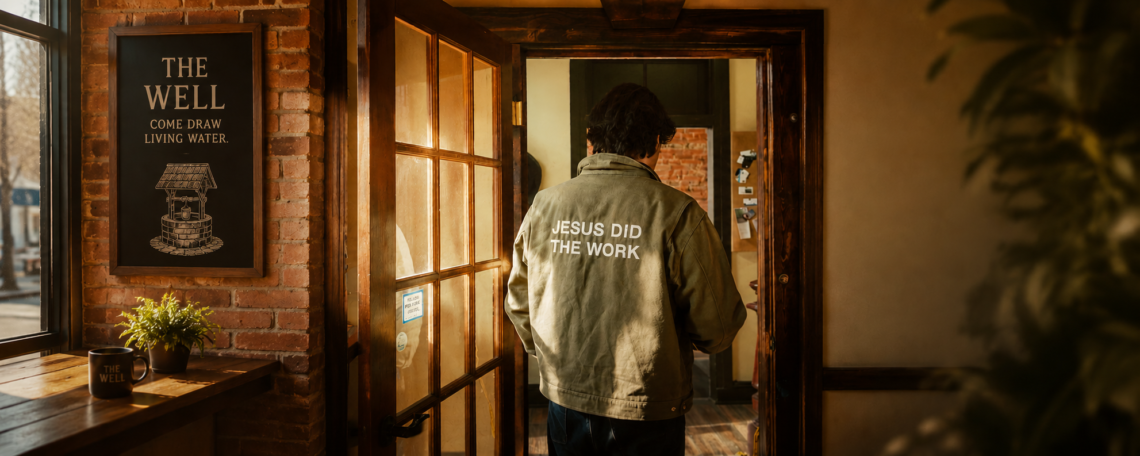
Eventually, the mission took on a name:
The Well.
A fitting name. A place where thirsty people come to draw water. A place to encounter Jesus. A place of conversation, where ordinary people meet God. I had the privilege of helping develop the name, create a loose brand identity and logo, and start the Instagram page. It became more than an assignment to many of us. It became personal.
By the end of the semester, we held four Saturday services at Exploration Commons at Carroll County Public Library. And remarkably, people came. Classmates served together. Messages were preached. Worship filled the room. What began as an uncertain classroom experiment had somehow become a functioning little church gathering. Not because anyone forced it into existence, but because God breathed on it.
In the end, I do not think the greatest lesson was how to plant a church. I think the greatest lesson was learning what the Church actually is. The Church is not ultimately a building. It is not branding. It is not budgets, attendance charts, or polished productions. The Church is people walking with Christ together. Serving together. Praying together. Trusting together. Obeying together. “The Well” felt mobile in the best possible sense. It reminded me that we are pilgrims. This world is not our home. Our roots are ultimately planted in Christ, not merely in a physical structure. Ironically, by not obsessing over building a church, we may have stumbled into becoming one.
And maybe that was the lesson all along.
I do not think any of us will ever forget this experience. Not because it was massive. (It wasn’t at all). Not because it became famous. (None of us would have wanted that anyway). But simply because it was real. There was something pure about it. A group of believers saying yes to God without fully knowing what would happen next, and then watching Him faithfully meet us there, week after week.
Looking back now, I honestly believe “The Well” became more than a class project. It became a stream of living water flowing through a town, and through all of us. And I think every single one of us left changed because of it.



One Comment
Julie Bond
Reading these words, I was transported into the little town of Westminster for such a time as this!!
Such a privilege to experience the LOVE, LOYALTY and LAVISHNESS of JESUS.
Will cherish forever….
JB